

地产投资回报指标不仅用于衡量收益,更对投资决策具有重要指导意义。通过综合运用这些指标,投资者可以更科学地选择项目、控制风险、优化资产配置,实现回报最大化。

Passive real estate investors will often find themselves bombarded with various deals to consider. Making sense of each opportunity to buy investment property can take time. Evaluating deals is some combination of art and science. Understanding the nuances of the local marketplace, competition, etc. is the art. The science involves digging into the numbers and deciphering each deal’s return on investment.
被动的房地产投资者经常会发现自己被各种交易轰炸,需要考虑。把握每一个购买投资物业的机会可能需要时间。评估交易是艺术与科学的某种结合。了解当地市场、竞争等的细微差别是一门艺术。这门科学涉及深入研究数字并破译每笔交易的投资回报率。
There are many ways to evaluate a deal’s return potential. Some of the most common real estate investment return metrics. Such as cash-on-cash-return, annual average return, equity multiple, and IRR; are all calculated differently. What’s more, these numbers may matter more or less to an investor depending on their specific investment objectives.
评估交易的回报潜力的方法有很多。一些最常见的房地产投资回报指标。如现金返还、年平均回报、净值倍数和 IRR;的计算方式都不同。更重要的是,这些数字对投资者来说可能或多或少重要,具体取决于他们的具体投资目标。
The Four Most Common Metrics Used to Evaluate CRE Returns
用于评估 CRE 回报的四个最常见指标
1. Cash on Cash Return 现金返还 (CoCR)
The CoCR is defined as the annual return that’s based on your invested amount. The formula is as follows:
CoCR 定义为基于您的投资金额的年回报率。公式如下:

Annual cash flow is calculated by taking the net operating income (NOI) and subtracting the operating expenses.
年度现金流量的计算方法是将净营业收入 (NOI) 减去营业费用。
Here’s a simple example.
下面是一个简单的示例。
Annual cash flow = $10,000
年现金流 = 10000 美元
Total investment = $100,000
总投资额 = 100,000 美元
CoCR = $10,000 / $100,000 = 10% CoCR
CoCR = 10,000 美元 / 100,000 美元 = 10% CoCR
CoCR is the preferred metric by many investors. This is simply because it allows them to easily compare a real estate deal to other investment alternatives. For example a stock’s performance during the same period.
CoCR 是许多投资者的首选指标。这仅仅是因为它使他们能够轻松地将房地产交易与其他投资选择进行比较。例如,一只股票在同一时期的表现。
It should be noted, that the CoCR is used to express the average returns over the lifetime of the deal. Therefore, many prospective investors will see deals advertised with CoCR’s that are provided as a range, such as 10-12%. The actual CoCR earned in any given year depends on the net operating income and expenses, which can vary from year to year.
应该注意的是,CoCR 用于表示交易生命周期内的平均回报。因此,许多潜在投资者会看到 CoCR 的广告交易,这些交易以 10-12% 的范围提供。在任何给定年份赚取的实际 CoCR 取决于净营业收入和支出,每年都可能有所不同。
Moreover, the CoCR does not account for any profit earned at the exit of the deal. For instance, using the example above, if the sponsor sells the property and investors earn another $50,000 upon sale, the CoCR does not capture those proceeds. If the sales proceeds were included. This would then amplify the total return on investment.
此外,CoCR 不考虑交易退出时赚取的任何利润。例如,使用上面的示例,如果发起人出售了房产,而投资者在出售后又赚取了 50,000 美元,则 CoCR 不会捕获这些收益。如果包括销售收益。这将放大总投资回报。
In that same regard, another limitation of CoCR is the cash flow. Any cash flow that is earned earlier in the hold period, may be less than what is earned after value-add improvements are made. This makes it imperative for investors to look at the target distribution schedule across the lifetime of the investment. If someone looks at the CoCR in the early years of an investment, it may look less attractive than the latter half of the hold period.
在这方面,CoCR 的另一个限制是现金流。在保留期早期获得的任何现金流都可能少于进行增值改进后获得的金额。这使得投资者必须查看整个投资生命周期的目标分配时间表。如果有人在投资的早期查看 CoCR,它可能看起来不如持有期的后半段有吸引力。
2. Annual Average Return 年平均回报率 (AAR)
The AAR is defined as the total return averaged throughout the life of a deal. The formula for AAR is as follows:
AAR 定义为整个交易生命周期的平均总回报。AAR 的公式如下:

Total profit includes total cash flow (NOI minus operating expenses) as well as any proceeds from the sale of the investment property.
总利润包括总现金流(净营业收入减去运营费用)以及出售投资物业的任何收益。
For example: 例如:
Annual cash flow = $5,000
年现金流 = 5000 美元
Sales proceeds = $100,000
销售收入 = 100,000 美元
Total investment = $100,000
总投资额 = 100,000 美元
Hold Period = 5 years
保留期 = 5 年
Total Profit: $5,000 x 5 years = $25,000 + $100,000 (sales proceeds)
总利润:5,000 美元 x 5 年 = 25,000 美元 + 100,000 美元(销售收益)
Total Profit = $125,000 总利润 = 125,000 美元
Therefore: 因此:
AAR = ($125,000 / $100,000) / 5 years
AAR = (125000 USD / 100000 USD) / 5 年
AAR = 0.25 or 25%
AAR = 0.25 或 25%
The AAR is generally calculated using a 3, 5, or 10-year period.
AAR 通常使用 3 年、5 年或 10 年期计算。
It’s worth noting that AAR is not the same as the annualized total return. The annualized total return captures the effects of compounding, whereas AAR does not.
值得注意的是,AAR 与年化总回报不同。年化总回报捕捉了复利的影响,而 AAR 则没有。
The Annual Average Return (AAR) is defined as the total return averaged throughout the life of a deal.
年平均回报 (AAR) 定义为整个交易生命周期的平均总回报。
For example, a deal may lose 50% of its value in Year 1. However, it may have a 100% return in Year 2. This is after the property improvements have been made. This would be an AAR of 25% per year—even though the investor hasn’t really “earned” anything; they’ve simply broken even at the end of Year 2. In this case, the annualized total return would be 0% after two years.
例如,交易在第 1 年可能会损失 50% 的价值。但是,它在第 2 年可能会有 100% 的回报。这是在进行物业改进之后。这将是每年 25% 的 AAR——即使投资者并没有真正“赚取”任何东西;他们只是在第二年结束时收支平衡。在这种情况下,两年后的年化总回报率将为 0%。
3. Equity Multiple (EM) 3. 净值倍数 (EM)
The equity multiple, or EM, is defined as the accumulated multiple of your investment at the end of an investment cycle. The formula is as follows:
净值倍数 (EM) 定义为您在投资周期结束时的累积倍数。公式如下:
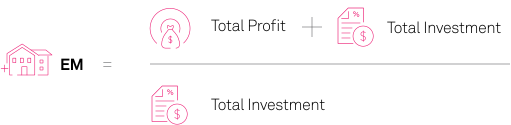
For example: 例如:
Total profit = $125,000 总利润 = 125,000 美元
Total investment = $100,000
总投资额 = 100,000 美元
EM = ($125,000 + $100,000) / $100,000
净值倍数 = (125000 USD + 100000 USD) / 100000 USD
EM = $225,000 / $100,000 = 2.25x
净值倍数 = 225,000 美元 / 100,000 美元 = 2.25 倍
Simply put, another way of saying a 2x multiple is that you just doubled your money. You might also say that you received your initial investment back, plus 100%.
简单地说,2 倍倍数的另一种说法是你刚刚把你的钱翻了一番。您也可以说您收回了初始投资加上 100%。
One of the benefits to using EM is that it accounts for all sources of income. This includes the future value of the property (the sales price), cash flow distributions, and any interest or preferred return paid on capital.
使用 EM 的好处之一是它涵盖了所有收入来源。这包括房产的未来价值(销售价格)、现金流分配以及支付的任何利息或优先资本回报。
A key consideration when using EM is that it does not tell you how long it took you to earn that return on your investment. For instance, one might argue that a 3.25x multiple earned in 8 years is not as attractive as a deal that earns a 2.5x multiple in just four years.
使用 EM 时的一个关键考虑因素是,它不会告诉您需要多长时间才能获得投资回报。例如,有人可能会争辩说,在 8 年内赚取 3.25 倍倍数不如在短短 4 年内赚取 2.5 倍倍数的交易有吸引力。
4. Internal Rate of Return (IRR)
4. 内部收益率 (IRR)
IRR is by far the most difficult investment metric to understand relative to the other real estate investment return metrics featured here today. This is because IRR is grounded in the economic principle known as the “time value of money”.
相对于今天在这里介绍的其他房地产投资回报指标,IRR 是迄今为止最难理解的投资指标。这是因为 IRR 以被称为“货币时间价值”的经济原理为基础。
Essentially, the time value of money principle assumes that a dollar earned today is more valuable than a dollar earned in the future. This is because over time, inflation cuts into the value of that dollar. Additionally, there are opportunity costs associated with earning that money later in time.
从本质上讲,货币时间价值原则假设今天赚的一美元比未来赚的一美元更有价值。这是因为随着时间的推移,通货膨胀会削弱该美元的价值。此外,还有与以后赚取这笔钱相关的机会成本。
In short, while IRR is the most difficult return metric to calculate, it is also the most thorough. This is because it takes into consideration when each dollar of profit is earned, and accounting for that accordingly. The sooner someone earns that money, the sooner they can re-invest it and put that money back to work.
简而言之,虽然 IRR 是最难计算的回报指标,但它也是最彻底的。这是因为它考虑了何时赚取每一美元的利润,并相应地考虑这一点。有人越早赚到这笔钱,他们就能越早将其再投资并将这笔钱重新投入工作。
The “textbook” definition of IRR is that it is a discount rate that generates a net present value (NPV) of zero for all streams of future cash flow.
IRR 的“教科书”定义是,它是一种贴现率,为所有未来现金流产生零的净现值 (NPV)。
Rarely will anyone calculate the IRR using pen and paper. It’s simply too complicated. Instead, people will generally use Excel or an investment calculator to calculate IRR.
很少有人会用笔和纸来计算 IRR。这实在是太复杂了。相反,人们通常会使用 Excel 或投资计算器来计算 IRR。
The best way to understand IRR is by looking at a few scenarios.
了解 IRR 的最佳方法是查看几种情况。
Scenario A 场景 A
Initial investment = $100,000
初始投资 = 100,000 美元
Cash flow earned during hold period = $0
暂停期内赚取的现金流 = 0 USD
Proceeds from sale = $200,000
销售收益 = 200,000 美元
Hold period = 5 years
保留期 = 5 年
In this case, the profit would be $100,000 or a 2x multiple.
在这种情况下,利润将为 100,000 美元或 2 倍。
Scenario B 场景 B
Initial investment = $100,000
初始投资 = 100,000 美元
Cash flow during hold period = $5,000 per year
冻结期内的现金流 = 每年 5000 USD
Cash-Out Refinance in Year 2 = $50,000
第 2 年的提现再融资 = 50,000 美元
Proceeds from sale = $130,000
销售收益 = 130,000 美元
Hold period = 5 years
保留期 = 5 年
In both of these scenarios, the total profit was the same: $200,000 at the end of the 5-year hold period. However, in Scenario A, that money is returned to investors at the end of Year 5. In Scenario B, that cash flow is returned to investors incrementally, including a $55,000 return in Year 3.
在这两种情况下,总利润都是相同的:5 年持有期结束时为 200,000 美元。但是,在情景 A 中,这笔钱在第 5 年结束时退还给投资者。在情景 B 中,现金流以增量方式返还给投资者,包括第 3 年的 55,000 美元回报。
This translates into a 14.9% IRR for Scenario A and a 20% IRR for Scenario B. This is a rather dramatic jump in IRR since both deals had the same 5-year hold period and same total profit. However, the IRR in Scenario B is higher because the investors received their returns sooner.
这意味着情景 A 的 IRR 为 14.9%,情景 B 的 IRR 为 20%。这是 IRR 的相当戏剧性的跃升,因为两笔交易具有相同的 5 年持有期和相同的总利润。然而,情景 B 中的 IRR 更高,因为投资者更早收到回报。
IRR, often considered the “gold standard” of investment metrics, has its own limitations. Consider the following.
IRR 通常被认为是投资指标的“黄金标准”,但也有其自身的局限性。请考虑以下几点。
First, sponsors can easily manipulate IRR. For example, they can take on additional debt to boost IRR. This can be problematic if the sponsor becomes too highly levered amid a market correction. This can wipe out investors’ equity and cause the IRR to plummet.
首先,项目保荐人可以轻松纵 IRR。例如,他们可以承担额外的债务来提高 IRR。如果保荐人在市场调整期间杠杆率过高,这可能会带来问题。这可能会抹去投资者的权益并导致 IRR 暴跌。
Similarly, sponsors may take out short-term credit facilities to delay making capital calls. In delaying when “committed” capital is invested. It shortens the “investment” period. Therefore boosting the IRR.
同样,保荐人可能会获得短期信贷安排以延迟进行资本催缴。延迟投资“承诺”资本的时间。它缩短了“投资”周期。因此提高了 IRR.
Other Key Considerations
其他关键考虑因素
Here are a few other key considerations for passive investors trying to make sense of these different metrics.
以下是被动投资者试图理解这些不同指标的其他一些关键考虑因素。
- Each of these real estate investment return metrics has its own limitations. Many of those limitations in have already been discussed above.
这些房地产投资回报指标中的每一个都有其自身的局限性。其中许多限制在上面已经讨论过。 - Many sponsors will often pitch investors claiming that their investment property deals promise to earn “double-digit returns” – and when using AAR, this is often the case. Prospective investors will want to clarify whether the sponsor is referring to double-digit CoC returns or AAR returns, as the numbers are dramatically different in terms of actual profit.
许多赞助商经常会向投资者推销,声称他们的投资房地产交易有望获得“两位数的回报”——而在使用 AAR 时,情况往往如此。潜在投资者将希望澄清保荐人指的是两位数的 CoC 回报还是 AAR 回报,因为这些数字在实际利润方面存在巨大差异。 - When investing in a stabilized investment property, look at its historical performance and current annual returns vs. the sponsor’s projections. Unless the sponsor is planning to make significant capital improvements, there should not be a major difference year to year. If there is, ask the sponsor to explain why they have drawn those conclusions.
在投资稳定的投资物业时,请查看其历史表现和当前年回报率与发起人的预测。除非发起人计划进行重大的资本改进,否则每年不应有重大差异。如果有,请让申办者解释他们为什么得出这些结论。 - Achieving certain returns often depends on how much debt the sponsor puts on the investment property. Often, the mortgage rate (influenced by the current interest rate) will impact a deal’s profitability.
获得一定的回报通常取决于发起人对投资物业的债务金额。通常,抵押贷款利率(受当前利率影响)会影响交易的盈利能力。 - Investors will also compare these metrics to the anticipated “cap rate” or capitalization rate. The cap rate for an investment property is the Net Operating Income (NOI) divided by the purchase price. Cap rates do not factor in any mortgage, and therefore, current interest rates do not carry as much weight as they would with the CoCR calculation.
投资者还将这些指标与预期的“ 资本化率 ”或资本化率进行比较。投资物业的上限率是净营业收入 (NOI) 除以购买价格。上限利率不考虑任何抵押贷款,因此,当前利率的权重不如 CoCR 计算。
Which Real Estate Investment Return Metric is “Best”?
哪个房地产投资回报指标是“最佳”?
Naturally, most investors will want to know which of these metrics is “best” to focus on. Yet in practice, none is inherently “better” than the others. Each is important for its own reasons, and all should be used in conjunction with the others.
自然,大多数投资者都想知道哪些指标是“最好”关注的。然而,在实践中,没有一个系统本质上比其他系统“更好”。每个方法都有其自身的原因,并且都应该与其他方法结合使用。
It’s also important for investors to utilize these metrics in the context of their own goals. For example, someone may prefer to earn a larger overall return (EM), regardless of when that return is earned (lower IRR).
对于投资者来说,在自己的目标背景下利用这些指标也很重要。例如,某人可能更愿意获得更高的总体回报 (EM),而不管何时获得该回报(较低的 IRR)。
There may be unique reasons to prefer earning returns at one time vs. another, especially as it pertains to tax saving strategies. For example, someone may be carrying forward a large loss related to the depreciation of one asset and may need to apply that depreciation to other passive income sooner rather than later. Another investor may expect to move from one tax bracket to another in a few years, and therefore may prefer to earn a lump sum at a later date.
可能有独特的理由让您更喜欢在某个时间赚取回报,尤其是当它与节税策略有关时。例如,某人可能结转了与一项资产折旧相关的大额损失,并且可能需要尽早将该折旧应用于其他被动收入。另一位投资者可能希望在几年内从一个税级转移到另一个税级,因此可能更愿意在以后一次性赚取一笔款项。
In any event, investors must understand how these metrics are calculated in order to evaluate deals with confidence. Understanding the nuances of each will allow investors to weed out the good deals from the great deal. What’s more, they’ll be able to steer clear of potentially bad deals altogether.
无论如何,投资者必须了解这些指标是如何计算的,以便有信心地评估交易。了解每个交易的细微差别将使投资者能够从大交易中筛选出好交易。更重要的是,他们将能够完全避开潜在的不良交易。
Conclusion 结论
If you’re interested in earning passive income, a great way to get started is investing in real estate. Many sponsors allow people to invest with as little as $25,000 to $50,000. Depending on the type of deal, some investors will be able to double their money (or more!) over the course of the hold period.
如果您有兴趣赚取被动收入,那么投资房地产是一个很好的开始方式。许多赞助商允许人们以低至 25,000 至 50,000 美元的资金进行投资。根据交易的类型,一些投资者将能够在持有期内将他们的资金翻倍(或更多!
The key is investing with an adept sponsor who has a proven track record.
关键是与具有良好业绩记录的熟练赞助商一起投资。